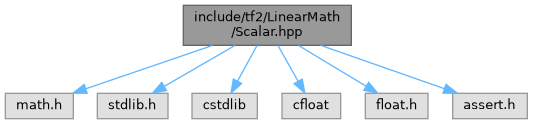
#include <math.h>
#include <stdlib.h>
#include <cstdlib>
#include <cfloat>
#include <float.h>
#include <assert.h>
Go to the source code of this file.
|
| typedef double | tf2Scalar |
| | The tf2Scalar type abstracts floating point numbers, to easily switch between double and single floating point precision.
|
| |
|
| tf2Scalar | tf2Sqrt (tf2Scalar x) |
| |
| tf2Scalar | tf2Fabs (tf2Scalar x) |
| |
| tf2Scalar | tf2Cos (tf2Scalar x) |
| |
| tf2Scalar | tf2Sin (tf2Scalar x) |
| |
| tf2Scalar | tf2Tan (tf2Scalar x) |
| |
| tf2Scalar | tf2Acos (tf2Scalar x) |
| |
| tf2Scalar | tf2Asin (tf2Scalar x) |
| |
| tf2Scalar | tf2Atan (tf2Scalar x) |
| |
| tf2Scalar | tf2Atan2 (tf2Scalar x, tf2Scalar y) |
| |
| tf2Scalar | tf2Exp (tf2Scalar x) |
| |
| tf2Scalar | tf2Log (tf2Scalar x) |
| |
| tf2Scalar | tf2Pow (tf2Scalar x, tf2Scalar y) |
| |
| tf2Scalar | tf2Fmod (tf2Scalar x, tf2Scalar y) |
| |
| tf2Scalar | tf2Atan2Fast (tf2Scalar y, tf2Scalar x) |
| |
| bool | tf2FuzzyZero (tf2Scalar x) |
| |
| bool | tf2Equal (tf2Scalar a, tf2Scalar eps) |
| |
| bool | tf2GreaterEqual (tf2Scalar a, tf2Scalar eps) |
| |
| int | tf2IsNegative (tf2Scalar x) |
| |
| tf2Scalar | tf2Radians (tf2Scalar x) |
| |
| tf2Scalar | tf2Degrees (tf2Scalar x) |
| |
| tf2Scalar | tf2Fsel (tf2Scalar a, tf2Scalar b, tf2Scalar c) |
| |
| bool | tf2MachineIsLittleEndian () |
| |
| unsigned | tf2Select (unsigned condition, unsigned valueIfConditionNonZero, unsigned valueIfConditionZero) |
| |
| int | tf2Select (unsigned condition, int valueIfConditionNonZero, int valueIfConditionZero) |
| |
| float | tf2Select (unsigned condition, float valueIfConditionNonZero, float valueIfConditionZero) |
| |
| template<typename T > |
| void | tf2Swap (T &a, T &b) |
| |
| unsigned | tf2SwapEndian (unsigned val) |
| |
| unsigned short | tf2SwapEndian (unsigned short val) |
| |
| unsigned | tf2SwapEndian (int val) |
| |
| unsigned short | tf2SwapEndian (short val) |
| |
| unsigned int | tf2SwapEndianFloat (float d) |
| | tf2SwapFloat uses using char pointers to swap the endianness
|
| |
| float | tf2UnswapEndianFloat (unsigned int a) |
| |
| void | tf2SwapEndianDouble (double d, unsigned char *dst) |
| |
| double | tf2UnswapEndianDouble (const unsigned char *src) |
| |
| tf2Scalar | tf2NormalizeAngle (tf2Scalar angleInRadians) |
| |
◆ TF2SIMD_FORCE_INLINE
| #define TF2SIMD_FORCE_INLINE inline |
◆ ATTRIBUTE_ALIGNED16
| #define ATTRIBUTE_ALIGNED16 |
( |
|
a | ) |
a |
◆ ATTRIBUTE_ALIGNED64
| #define ATTRIBUTE_ALIGNED64 |
( |
|
a | ) |
a |
◆ ATTRIBUTE_ALIGNED128
| #define ATTRIBUTE_ALIGNED128 |
( |
|
a | ) |
a |
◆ tf2Assert
◆ tf2FullAssert
| #define tf2FullAssert |
( |
|
x | ) |
|
◆ tf2Likely
| #define tf2Likely |
( |
|
_c | ) |
_c |
◆ tf2Unlikely
| #define tf2Unlikely |
( |
|
_c | ) |
_c |
◆ TF2_LARGE_FLOAT
| #define TF2_LARGE_FLOAT 1e30 |
◆ TF2_DECLARE_ALIGNED_ALLOCATOR
| #define TF2_DECLARE_ALIGNED_ALLOCATOR |
( |
| ) |
|
Value: TF2SIMD_FORCE_INLINE void*
operator new(
size_t sizeInBytes) {
return tf2AlignedAlloc(sizeInBytes,16); } \
TF2SIMD_FORCE_INLINE void*
operator new[](
size_t sizeInBytes) {
return tf2AlignedAlloc(sizeInBytes,16); } \
#define TF2SIMD_FORCE_INLINE
Definition Scalar.hpp:129
◆ TF2SIMD_2_PI
| #define TF2SIMD_2_PI tf2Scalar(6.283185307179586232) |
◆ TF2SIMD_PI
◆ TF2SIMD_HALF_PI
◆ TF2SIMD_RADS_PER_DEG
◆ TF2SIMD_DEGS_PER_RAD
◆ TF2SIMDSQRT12
| #define TF2SIMDSQRT12 tf2Scalar(0.7071067811865475244008443621048490) |
◆ tf2RecipSqrt
◆ TF2SIMD_EPSILON
| #define TF2SIMD_EPSILON DBL_EPSILON |
◆ TF2SIMD_INFINITY
| #define TF2SIMD_INFINITY DBL_MAX |
◆ TF2_DECLARE_HANDLE
| #define TF2_DECLARE_HANDLE |
( |
|
name | ) |
typedef struct name##__ { int unused; } *name |
◆ tf2Fsels
◆ tf2Scalar
The tf2Scalar type abstracts floating point numbers, to easily switch between double and single floating point precision.
◆ tf2Sqrt()
◆ tf2Fabs()
◆ tf2Cos()
◆ tf2Sin()
◆ tf2Tan()
◆ tf2Acos()
◆ tf2Asin()
◆ tf2Atan()
◆ tf2Atan2()
◆ tf2Exp()
◆ tf2Log()
◆ tf2Pow()
◆ tf2Fmod()
◆ tf2Atan2Fast()
◆ tf2FuzzyZero()
◆ tf2Equal()
◆ tf2GreaterEqual()
◆ tf2IsNegative()
◆ tf2Radians()
◆ tf2Degrees()
◆ tf2Fsel()
◆ tf2MachineIsLittleEndian()
| bool tf2MachineIsLittleEndian |
( |
| ) |
|
◆ tf2Select() [1/3]
| unsigned tf2Select |
( |
unsigned |
condition, |
|
|
unsigned |
valueIfConditionNonZero, |
|
|
unsigned |
valueIfConditionZero |
|
) |
| |
◆ tf2Select() [2/3]
| int tf2Select |
( |
unsigned |
condition, |
|
|
int |
valueIfConditionNonZero, |
|
|
int |
valueIfConditionZero |
|
) |
| |
◆ tf2Select() [3/3]
| float tf2Select |
( |
unsigned |
condition, |
|
|
float |
valueIfConditionNonZero, |
|
|
float |
valueIfConditionZero |
|
) |
| |
◆ tf2Swap()
template<typename T >
| void tf2Swap |
( |
T & |
a, |
|
|
T & |
b |
|
) |
| |
◆ tf2SwapEndian() [1/4]
| unsigned tf2SwapEndian |
( |
unsigned |
val | ) |
|
◆ tf2SwapEndian() [2/4]
| unsigned short tf2SwapEndian |
( |
unsigned short |
val | ) |
|
◆ tf2SwapEndian() [3/4]
| unsigned tf2SwapEndian |
( |
int |
val | ) |
|
◆ tf2SwapEndian() [4/4]
| unsigned short tf2SwapEndian |
( |
short |
val | ) |
|
◆ tf2SwapEndianFloat()
| unsigned int tf2SwapEndianFloat |
( |
float |
d | ) |
|
tf2SwapFloat uses using char pointers to swap the endianness
tf2SwapFloat/tf2SwapDouble will NOT return a float, because the machine might 'correct' invalid floating point values Not all values of sign/exponent/mantissa are valid floating point numbers according to IEEE 754. When a floating point unit is faced with an invalid value, it may actually change the value, or worse, throw an exception. In most systems, running user mode code, you wouldn't get an exception, but instead the hardware/os/runtime will 'fix' the number for you. so instead of returning a float/double, we return integer/long long integer
◆ tf2UnswapEndianFloat()
| float tf2UnswapEndianFloat |
( |
unsigned int |
a | ) |
|
◆ tf2SwapEndianDouble()
| void tf2SwapEndianDouble |
( |
double |
d, |
|
|
unsigned char * |
dst |
|
) |
| |
◆ tf2UnswapEndianDouble()
| double tf2UnswapEndianDouble |
( |
const unsigned char * |
src | ) |
|
◆ tf2NormalizeAngle()