Public Member Functions | |
| def | FromDatetime (self, dt) |
| def | FromDatetime (self, dt) |
| def | FromJsonString (self, value) |
| def | FromJsonString (self, value) |
| def | FromMicroseconds (self, micros) |
| def | FromMicroseconds (self, micros) |
| def | FromMilliseconds (self, millis) |
| def | FromMilliseconds (self, millis) |
| def | FromNanoseconds (self, nanos) |
| def | FromNanoseconds (self, nanos) |
| def | FromSeconds (self, seconds) |
| def | FromSeconds (self, seconds) |
| def | GetCurrentTime (self) |
| def | GetCurrentTime (self) |
| def | ToDatetime (self) |
| def | ToDatetime (self) |
| def | ToJsonString (self) |
| def | ToJsonString (self) |
| def | ToMicroseconds (self) |
| def | ToMicroseconds (self) |
| def | ToMilliseconds (self) |
| def | ToMilliseconds (self) |
| def | ToNanoseconds (self) |
| def | ToNanoseconds (self) |
| def | ToSeconds (self) |
| def | ToSeconds (self) |
Public Attributes | |
| nanos | |
| seconds | |
Static Private Attributes | |
| tuple | __slots__ = () |
Detailed Description
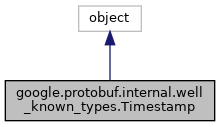
Class for Timestamp message type.
Definition at line 102 of file bloaty/third_party/protobuf/python/google/protobuf/internal/well_known_types.py.
Member Function Documentation
◆ FromDatetime() [1/2]
| def google.protobuf.internal.well_known_types.Timestamp.FromDatetime | ( | self, | |
| dt | |||
| ) |
Converts datetime to Timestamp.
Definition at line 240 of file protobuf/python/google/protobuf/internal/well_known_types.py.
◆ FromDatetime() [2/2]
| def google.protobuf.internal.well_known_types.Timestamp.FromDatetime | ( | self, | |
| dt | |||
| ) |
Converts datetime to Timestamp.
Definition at line 241 of file bloaty/third_party/protobuf/python/google/protobuf/internal/well_known_types.py.
◆ FromJsonString() [1/2]
| def google.protobuf.internal.well_known_types.Timestamp.FromJsonString | ( | self, | |
| value | |||
| ) |
Parse a RFC 3339 date string format to Timestamp.

Args:
  value: A date string. Any fractional digits (or none) and any offset are
  accepted as long as they fit into nano-seconds precision.
  Example of accepted format: '1972-01-01T10:00:20.021-05:00'

Raises:
  ValueError: On parsing problems.
Definition at line 128 of file protobuf/python/google/protobuf/internal/well_known_types.py.
◆ FromJsonString() [2/2]
| def google.protobuf.internal.well_known_types.Timestamp.FromJsonString | ( | self, | |
| value | |||
| ) |
Parse a RFC 3339 date string format to Timestamp.

Args:
  value: A date string. Any fractional digits (or none) and any offset are
  accepted as long as they fit into nano-seconds precision.
  Example of accepted format: '1972-01-01T10:00:20.021-05:00'

Raises:
  ValueError: On parsing problems.
Definition at line 135 of file bloaty/third_party/protobuf/python/google/protobuf/internal/well_known_types.py.
◆ FromMicroseconds() [1/2]
| def google.protobuf.internal.well_known_types.Timestamp.FromMicroseconds | ( | self, | |
| micros | |||
| ) |
Converts microseconds since epoch to Timestamp.
Definition at line 219 of file protobuf/python/google/protobuf/internal/well_known_types.py.
◆ FromMicroseconds() [2/2]
| def google.protobuf.internal.well_known_types.Timestamp.FromMicroseconds | ( | self, | |
| micros | |||
| ) |
Converts microseconds since epoch to Timestamp.
Definition at line 220 of file bloaty/third_party/protobuf/python/google/protobuf/internal/well_known_types.py.
◆ FromMilliseconds() [1/2]
| def google.protobuf.internal.well_known_types.Timestamp.FromMilliseconds | ( | self, | |
| millis | |||
| ) |
Converts milliseconds since epoch to Timestamp.
Definition at line 224 of file protobuf/python/google/protobuf/internal/well_known_types.py.
◆ FromMilliseconds() [2/2]
| def google.protobuf.internal.well_known_types.Timestamp.FromMilliseconds | ( | self, | |
| millis | |||
| ) |
Converts milliseconds since epoch to Timestamp.
Definition at line 225 of file bloaty/third_party/protobuf/python/google/protobuf/internal/well_known_types.py.
◆ FromNanoseconds() [1/2]
| def google.protobuf.internal.well_known_types.Timestamp.FromNanoseconds | ( | self, | |
| nanos | |||
| ) |
Converts nanoseconds since epoch to Timestamp.
Definition at line 214 of file protobuf/python/google/protobuf/internal/well_known_types.py.
◆ FromNanoseconds() [2/2]
| def google.protobuf.internal.well_known_types.Timestamp.FromNanoseconds | ( | self, | |
| nanos | |||
| ) |
Converts nanoseconds since epoch to Timestamp.
Definition at line 215 of file bloaty/third_party/protobuf/python/google/protobuf/internal/well_known_types.py.
◆ FromSeconds() [1/2]
| def google.protobuf.internal.well_known_types.Timestamp.FromSeconds | ( | self, | |
| seconds | |||
| ) |
Converts seconds since epoch to Timestamp.
Definition at line 229 of file protobuf/python/google/protobuf/internal/well_known_types.py.
◆ FromSeconds() [2/2]
| def google.protobuf.internal.well_known_types.Timestamp.FromSeconds | ( | self, | |
| seconds | |||
| ) |
Converts seconds since epoch to Timestamp.
Definition at line 230 of file bloaty/third_party/protobuf/python/google/protobuf/internal/well_known_types.py.
◆ GetCurrentTime() [1/2]
| def google.protobuf.internal.well_known_types.Timestamp.GetCurrentTime | ( | self | ) |
Get the current UTC into Timestamp.
Definition at line 192 of file protobuf/python/google/protobuf/internal/well_known_types.py.
◆ GetCurrentTime() [2/2]
| def google.protobuf.internal.well_known_types.Timestamp.GetCurrentTime | ( | self | ) |
Get the current UTC into Timestamp.
Definition at line 193 of file bloaty/third_party/protobuf/python/google/protobuf/internal/well_known_types.py.
◆ ToDatetime() [1/2]
| def google.protobuf.internal.well_known_types.Timestamp.ToDatetime | ( | self | ) |
Converts Timestamp to datetime.
Definition at line 234 of file protobuf/python/google/protobuf/internal/well_known_types.py.
◆ ToDatetime() [2/2]
| def google.protobuf.internal.well_known_types.Timestamp.ToDatetime | ( | self | ) |
Converts Timestamp to datetime.
Definition at line 235 of file bloaty/third_party/protobuf/python/google/protobuf/internal/well_known_types.py.
◆ ToJsonString() [1/2]
| def google.protobuf.internal.well_known_types.Timestamp.ToJsonString | ( | self | ) |
Converts Timestamp to RFC 3339 date string format.

Returns:
  A string converted from timestamp. The string is always Z-normalized
  and uses 3, 6 or 9 fractional digits as required to represent the
  exact time. Example of the return format: '1972-01-01T10:00:20.021Z'
Definition at line 100 of file protobuf/python/google/protobuf/internal/well_known_types.py.
◆ ToJsonString() [2/2]
| def google.protobuf.internal.well_known_types.Timestamp.ToJsonString | ( | self | ) |
Converts Timestamp to RFC 3339 date string format.

Returns:
  A string converted from timestamp. The string is always Z-normalized
  and uses 3, 6 or 9 fractional digits as required to represent the
  exact time. Example of the return format: '1972-01-01T10:00:20.021Z'
Definition at line 107 of file bloaty/third_party/protobuf/python/google/protobuf/internal/well_known_types.py.
◆ ToMicroseconds() [1/2]
| def google.protobuf.internal.well_known_types.Timestamp.ToMicroseconds | ( | self | ) |
Converts Timestamp to microseconds since epoch.
Definition at line 200 of file protobuf/python/google/protobuf/internal/well_known_types.py.
◆ ToMicroseconds() [2/2]
| def google.protobuf.internal.well_known_types.Timestamp.ToMicroseconds | ( | self | ) |
Converts Timestamp to microseconds since epoch.
Definition at line 201 of file bloaty/third_party/protobuf/python/google/protobuf/internal/well_known_types.py.
◆ ToMilliseconds() [1/2]
| def google.protobuf.internal.well_known_types.Timestamp.ToMilliseconds | ( | self | ) |
Converts Timestamp to milliseconds since epoch.
Definition at line 205 of file protobuf/python/google/protobuf/internal/well_known_types.py.
◆ ToMilliseconds() [2/2]
| def google.protobuf.internal.well_known_types.Timestamp.ToMilliseconds | ( | self | ) |
Converts Timestamp to milliseconds since epoch.
Definition at line 206 of file bloaty/third_party/protobuf/python/google/protobuf/internal/well_known_types.py.
◆ ToNanoseconds() [1/2]
| def google.protobuf.internal.well_known_types.Timestamp.ToNanoseconds | ( | self | ) |
Converts Timestamp to nanoseconds since epoch.
Definition at line 196 of file protobuf/python/google/protobuf/internal/well_known_types.py.
◆ ToNanoseconds() [2/2]
| def google.protobuf.internal.well_known_types.Timestamp.ToNanoseconds | ( | self | ) |
Converts Timestamp to nanoseconds since epoch.
Definition at line 197 of file bloaty/third_party/protobuf/python/google/protobuf/internal/well_known_types.py.
◆ ToSeconds() [1/2]
| def google.protobuf.internal.well_known_types.Timestamp.ToSeconds | ( | self | ) |
Converts Timestamp to seconds since epoch.
Definition at line 210 of file protobuf/python/google/protobuf/internal/well_known_types.py.
◆ ToSeconds() [2/2]
| def google.protobuf.internal.well_known_types.Timestamp.ToSeconds | ( | self | ) |
Converts Timestamp to seconds since epoch.
Definition at line 211 of file bloaty/third_party/protobuf/python/google/protobuf/internal/well_known_types.py.
Member Data Documentation
◆ __slots__
|
staticprivate |
Definition at line 105 of file bloaty/third_party/protobuf/python/google/protobuf/internal/well_known_types.py.
◆ nanos
| google.protobuf.internal.well_known_types.Timestamp.nanos |
Definition at line 191 of file bloaty/third_party/protobuf/python/google/protobuf/internal/well_known_types.py.
◆ seconds
| google.protobuf.internal.well_known_types.Timestamp.seconds |
Definition at line 190 of file bloaty/third_party/protobuf/python/google/protobuf/internal/well_known_types.py.
The documentation for this class was generated from the following file: