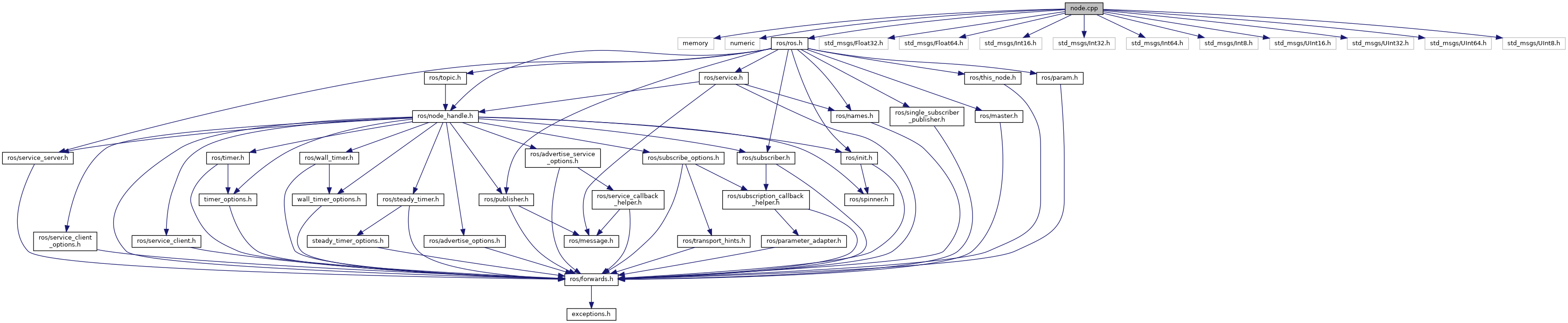
#include <memory>
#include <numeric>
#include <ros/ros.h>
#include <std_msgs/Float32.h>
#include <std_msgs/Float64.h>
#include <std_msgs/Int16.h>
#include <std_msgs/Int32.h>
#include <std_msgs/Int64.h>
#include <std_msgs/Int8.h>
#include <std_msgs/UInt16.h>
#include <std_msgs/UInt32.h>
#include <std_msgs/UInt64.h>
#include <std_msgs/UInt8.h>
Go to the source code of this file.
◆ callbackD()
template<class T , class U >
| void callbackD |
( |
const T & |
msg | ) |
|
◆ callbackFloat32()
| void callbackFloat32 |
( |
const std_msgs::Float32ConstPtr & |
msg | ) |
|
◆ callbackFloat64()
| void callbackFloat64 |
( |
const std_msgs::Float64ConstPtr & |
msg | ) |
|
◆ callbackI()
template<class T , class U >
| void callbackI |
( |
const T & |
msg | ) |
|
◆ callbackInt16()
| void callbackInt16 |
( |
const std_msgs::Int16ConstPtr & |
msg | ) |
|
◆ callbackInt32()
| void callbackInt32 |
( |
const std_msgs::Int32ConstPtr & |
msg | ) |
|
◆ callbackInt64()
| void callbackInt64 |
( |
const std_msgs::Int64ConstPtr & |
msg | ) |
|
◆ callbackInt8()
| void callbackInt8 |
( |
const std_msgs::Int8ConstPtr & |
msg | ) |
|
◆ callbackU()
template<class T , class U >
| void callbackU |
( |
const T & |
msg | ) |
|
◆ callbackUInt16()
| void callbackUInt16 |
( |
const std_msgs::UInt16ConstPtr & |
msg | ) |
|
◆ callbackUInt32()
| void callbackUInt32 |
( |
const std_msgs::UInt32ConstPtr & |
msg | ) |
|
◆ callbackUInt64()
| void callbackUInt64 |
( |
const std_msgs::UInt64ConstPtr & |
msg | ) |
|
◆ callbackUInt8()
| void callbackUInt8 |
( |
const std_msgs::UInt8ConstPtr & |
msg | ) |
|
◆ main()
| int main |
( |
int |
argc, |
|
|
char * |
argv[] |
|
) |
| |
◆ nh
◆ pub
◆ time_values_d
| std::vector<std::pair<ros::Time, double> > time_values_d |
◆ time_values_i
| std::vector<std::pair<ros::Time, int64_t> > time_values_i |
◆ time_values_u
| std::vector<std::pair<ros::Time, uint64_t> > time_values_u |
◆ window_length