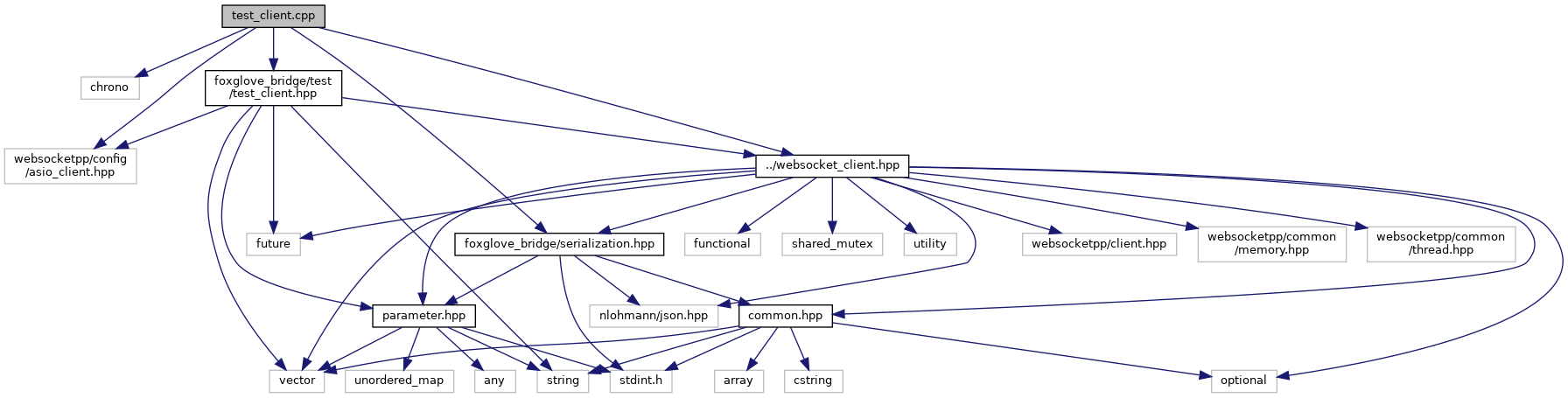
#include <chrono>#include <websocketpp/config/asio_client.hpp>#include <foxglove_bridge/serialization.hpp>#include <foxglove_bridge/test/test_client.hpp>#include <foxglove_bridge/websocket_client.hpp>
Include dependency graph for test_client.cpp:
Go to the source code of this file.
Namespaces | |
| foxglove | |
Macros | |
| #define | ASIO_STANDALONE |
Functions | |
| std::vector< uint8_t > | foxglove::connectClientAndReceiveMsg (const std::string &uri, const std::string &topic_name) |
| std::future< std::vector< Parameter > > | foxglove::waitForParameters (std::shared_ptr< ClientInterface > client, const std::string &requestId=std::string()) |
| std::future< Service > | foxglove::waitForService (std::shared_ptr< ClientInterface > client, const std::string &serviceName) |
| std::future< ServiceResponse > | foxglove::waitForServiceResponse (std::shared_ptr< ClientInterface > client) |
Variables | |
| constexpr auto | foxglove::DEFAULT_TIMEOUT = std::chrono::seconds(5) |
Macro Definition Documentation
◆ ASIO_STANDALONE
| #define ASIO_STANDALONE |
Definition at line 3 of file test_client.cpp.